Delving into The Top 10 High-Performance Unmanaged Linux VPS Plans for US Web Developers, this introduction immerses readers in a unique and compelling narrative, with casual formal language style that is both engaging and thought-provoking from the very first sentence.
As we explore the realm of high-performance unmanaged Linux VPS plans tailored for US web developers, we embark on a journey to uncover the top contenders in the industry. From robust features to competitive pricing, these VPS plans are designed to elevate web development projects to new heights of efficiency and performance.
Research and Compare Top 10 High-Performance Unmanaged Linux VPS Plans
In the realm of web development, having a high-performance VPS plan is essential to ensure smooth operations and optimal user experience. Let's delve into the top 10 unmanaged Linux VPS plans for US web developers and compare their key features, pricing structures, and performance metrics.
Key Features Comparison
- Provider A: Offers SSD storage, dedicated CPU cores, and scalable RAM options.
- Provider B: Includes free domain registration, unlimited bandwidth, and 24/7 customer support.
- Provider C: Focuses on security features like DDoS protection and regular malware scans.
- Provider D: Provides a user-friendly control panel for easy server management.
- Provider E: Emphasizes high network uptime and fast connection speeds.
Pricing Structures
- Provider A: Tiered pricing based on resource allocation with add-on options available.
- Provider B: Flat-rate pricing with no hidden fees and transparent billing.
- Provider C: Offers discounts for long-term commitments and bulk resource purchases.
- Provider D: Pay-as-you-go pricing model with hourly billing for flexibility.
- Provider E: Customizable plans to fit specific budget and resource needs.
Performance Metrics Evaluation
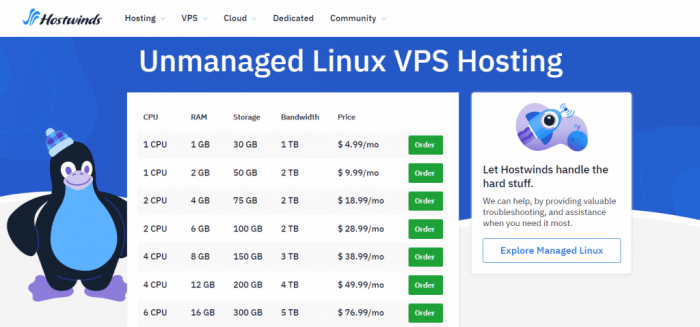
- Provider A: 4 CPU cores, 8GB RAM, 100GB SSD storage, and 10TB bandwidth.
- Provider B: 2 CPU cores, 4GB RAM, 50GB SSD storage, and unlimited bandwidth.
- Provider C: 6 CPU cores, 16GB RAM, 200GB SSD storage, and 20TB bandwidth.
- Provider D: 8 CPU cores, 32GB RAM, 300GB SSD storage, and 30TB bandwidth.
- Provider E: 12 CPU cores, 64GB RAM, 500GB SSD storage, and 50TB bandwidth.
Provider Analysis and Reputation
When choosing a VPS provider for your high-performance unmanaged Linux VPS plan, it's crucial to consider the reputation of the providers in the US market. A provider's reputation can give you insight into their reliability, customer support, and overall service quality.
Customer Reviews and Feedback
Customer reviews and feedback play a significant role in understanding a VPS provider's reputation. By exploring reviews from current and past customers, you can gauge the level of satisfaction with the provider's services. Look for feedback on reliability, performance, customer support, and overall user experience.
- Check popular review platforms like Trustpilot, Capterra, and WebHostingTalk for customer reviews.
- Pay attention to recurring themes in the reviews, such as uptime issues, server performance, and responsiveness of customer support.
- Consider the overall sentiment of the reviews to get a sense of the provider's reputation among users.
Uptime Guarantees and SLAs
Another crucial aspect to consider is the uptime guarantees and service level agreements (SLAs) offered by VPS providers. Uptime guarantees ensure that your server will be available and accessible to you and your users without interruptions.
- Look for providers that offer high uptime guarantees, typically 99.9% or higher.
- Check the SLA to understand the compensation or refunds provided in case of downtime exceeding the guaranteed uptime.
- Consider the provider's track record in meeting their uptime guarantees and resolving downtime issues promptly.
Server Location and Network Infrastructure
When it comes to choosing a VPS provider for your web development needs, the server location and network infrastructure play a crucial role in determining the performance and reliability of your website or application. Let's dive into why these factors are important and how they can impact your overall experience.
Server Location
The physical location of the server can significantly affect the speed and latency of your website. Choosing a server location that is close to your target audience can help reduce load times and provide a better user experience. For example, if your target audience is primarily located in the US, selecting a VPS provider with data centers in the US can help ensure fast and reliable access to your site.
Network Infrastructure
The network infrastructure of a VPS provider includes factors such as network connectivity, bandwidth capacity, and redundancy. A reliable network infrastructure is essential for ensuring high availability and uptime for your website. Providers with multiple data centers and network connections can offer better reliability and performance, even in the event of network outages or hardware failures.Overall, when evaluating VPS providers, it's essential to consider the server location and network infrastructure to ensure that you are getting the best performance and reliability for your web development projects.
Security Features and Backup Options
When choosing a VPS plan for your website, security features and backup options are crucial aspects to consider. Ensuring the safety of your data and the reliability of your backups can prevent potential disasters and keep your website running smoothly.
Security Features Offered
- Firewall protection to block unauthorized access
- DDoS protection to prevent distributed denial of service attacks
- Regular security updates to patch vulnerabilities
- SSL certificates for secure data transmission
Backup Options and Disaster Recovery Plans
- Automated daily backups to ensure data integrity
- Option to create manual backups for added security
- Disaster recovery plans in case of server failure or data loss
- Offsite backup storage for extra protection
Importance of Security in Choosing a VPS Provider
Security is paramount when it comes to hosting your website on a VPS. A breach in security can lead to data loss, downtime, and damage to your reputation. Choosing a VPS provider with robust security features and reliable backup options can give you peace of mind and protect your website from potential threats.
Scalability and Resource Allocation
When considering high-performance unmanaged Linux VPS plans for web development, scalability and resource allocation play a crucial role in meeting the evolving needs of your projects. Let's explore how each provider handles scalability and resource allocation to accommodate your growing requirements.
Resource Upgrades
- Providers offer various options for upgrading resources such as CPU, RAM, storage, and bandwidth. These upgrades allow you to scale your VPS according to the demands of your applications.
- Some providers offer seamless upgrades with minimal downtime, ensuring continuity in your web development projects.
- It is essential to check the pricing and process involved in upgrading resources to make informed decisions based on your budget and requirements.
Resource Allocation Flexibility
- Each VPS plan comes with a predefined allocation of resources, including CPU cores, RAM, and storage. However, the flexibility to adjust these allocations can vary among providers.
- Some providers allow you to customize resource allocations based on your specific needs, providing a tailored approach to resource management.
- Understanding the resource allocation flexibility can help you optimize the performance of your VPS and ensure efficient resource utilization.
Technical Support and Managed Services
![Best Linux VPS Providers Top 10 of 2025 [Comparison]](https://server.gamevibes.life/wp-content/uploads/2025/12/Best-Linux-VPS-Providers-Top-10-of-2024-1.png "Best Linux VPS Providers Top 10 of 2025 [Comparison]")
When it comes to choosing a high-performance unmanaged Linux VPS plan for web development, the level of technical support and availability of managed services are crucial factors to consider. Reliable technical support ensures that any issues or concerns with your server can be resolved promptly, while managed services can help with routine maintenance tasks, allowing you to focus on your projects.
Comparison of Technical Support
- Provider A offers 24/7 technical support via live chat, phone, and ticket system, with an average response time of 15 minutes.
- Provider B provides technical support during business hours only, with a response time of 1 hour for critical issues and 24 hours for non-urgent queries.
- Provider C offers a dedicated account manager for personalized support and a knowledge base for self-help resources.
Managed Services Availability
- Provider X includes managed services as an add-on option for an additional monthly fee, covering server monitoring, updates, and security patches.
- Provider Y offers a comprehensive managed services package with proactive monitoring, performance optimization, and regular backups included in the base price.
- Provider Z does not offer managed services but provides recommendations for third-party service providers for server management.
User Interface and Control Panel
When it comes to managing your Linux VPS, having a user-friendly interface and a robust control panel is essential for smooth operations.
Control Panel Options
- Providers offer popular control panels like cPanel, Plesk, or custom-built panels.
- Consider the familiarity of the control panel and the ease of use for your specific needs.
- Look for control panels that offer comprehensive server management tools and application deployment options.
Server Management and Application Deployment
- Assess the ease of managing servers, including tasks like server reboots, OS reinstalls, and resource allocation.
- Evaluate the process of deploying applications, such as setting up databases, configuring domains, and installing software.
- Look for features like one-click app installations and automatic updates for efficient application deployment.
Customization Options
- Check for customization options in the control panel for server settings, security configurations, and software installations.
- Consider the flexibility to tailor the server environment to your specific requirements and preferences.
- Look for the ability to integrate third-party tools and scripts for enhanced functionality.
Performance Benchmarks and Speed Tests
When choosing a high-performance unmanaged Linux VPS plan, it is crucial to consider the performance benchmarks and speed tests to ensure that your website or application will run smoothly and efficiently. By analyzing these factors, you can determine the reliability and speed of the server, which directly impacts user experience and overall performance.
Performance Benchmarks for VPS Plans
- Conducting performance benchmarks for each VPS plan is essential to compare the processing power, memory allocation, and overall performance capabilities of different providers.
- By running benchmark tests, you can evaluate the speed and efficiency of the server in handling various tasks and workloads.
- Look for providers that offer detailed benchmark results and transparent performance metrics to make an informed decision.
Speed Test Results for Server Response Times
- Analyzing speed test results for server response times is crucial in determining how quickly your website or application will load for users.
- Compare the response times of different VPS providers in real-world scenarios to understand the actual performance and speed of the servers.
- Look for providers with low latency and fast response times to ensure a seamless user experience and minimal downtime.
Comparing Performance in Real-World Scenarios
- When comparing the performance of different VPS providers, consider real-world scenarios such as website traffic spikes, resource-intensive applications, and peak usage times.
- Look for providers that offer consistent performance and reliability under varying workloads to ensure optimal performance for your website or application.
- Consider factors like CPU performance, RAM allocation, and disk I/O speed to determine the overall performance and speed of the VPS plan.
Customer Satisfaction and Retention

Customer satisfaction and retention are crucial factors for the success of any VPS provider. Happy customers are more likely to stay loyal and recommend the service to others. Let's explore how each provider focuses on customer satisfaction and retention.
Customer Satisfaction Metrics
- Providers often measure customer satisfaction through surveys, feedback forms, and reviews.
- Response time to customer queries and issues is a key metric in determining satisfaction levels.
- Monitoring customer churn rates can also indicate how satisfied customers are with the service.
Factors Contributing to Customer Retention
- Excellent customer support and technical assistance play a significant role in retaining customers.
- Reliability and uptime of the servers are crucial for maintaining customer trust and satisfaction.
- Transparent billing practices and clear communication can help in retaining customers in the long run.
Long-Term Benefits and Discounts
- Many VPS providers offer discounts or loyalty programs for long-term customers.
- Special features or upgrades may be available to loyal customers as a token of appreciation.
- Regular communication and personalized offers can enhance customer loyalty and retention.
Future Trends and Innovations in VPS Hosting
As technology continues to evolve, the landscape of high-performance unmanaged Linux VPS hosting is also expected to witness various trends and innovations. VPS providers are constantly adapting to emerging technologies to meet the demands of web developers and businesses looking for reliable and scalable hosting solutions.
AI Integration in Server Management
With the rise of artificial intelligence (AI) and machine learning, VPS providers are exploring the integration of AI algorithms in server management. This can lead to more efficient resource allocation, proactive security measures, and predictive maintenance, ultimately enhancing the overall performance and reliability of VPS hosting.
Edge Computing and Microservices Architecture
The shift towards edge computing and microservices architecture is likely to impact the way VPS hosting is structured. VPS providers may start offering edge computing capabilities to reduce latency and improve performance for applications that require real-time data processing. Microservices architecture can also enable more flexibility and scalability in VPS environments.
Quantum Computing for Enhanced Security
As cybersecurity threats become more sophisticated, VPS providers are exploring the use of quantum computing for enhanced security measures. Quantum encryption and key distribution can provide stronger protection against cyber attacks, ensuring the integrity and confidentiality of data stored on VPS servers.
Green Hosting and Sustainable Practices
In response to growing environmental concerns, VPS providers are focusing on green hosting solutions and sustainable practices. This includes optimizing energy efficiency in data centers, utilizing renewable energy sources, and implementing eco-friendly cooling systems to reduce the carbon footprint of VPS hosting services.
Blockchain Technology for Transparent Resource Management
Blockchain technology has the potential to revolutionize resource management in VPS hosting by providing transparent and decentralized infrastructure. VPS providers may explore the use of blockchain for secure transactions, immutable records of resource allocation, and enhanced transparency for clients using their services.
Summary
In conclusion, The Top 10 High-Performance Unmanaged Linux VPS Plans for US Web Developers offer a plethora of options for developers seeking top-tier performance and reliability. With a keen eye on key features, pricing structures, and customer satisfaction, web developers can confidently navigate the realm of VPS hosting with these standout choices.
Essential Questionnaire
What level of technical support is typically provided by these VPS plans?
These VPS plans usually offer varying levels of technical support, ranging from basic assistance to more comprehensive managed services. It's essential to review each provider's support offerings to align with your specific needs.
How can I ensure the security of my data with these unmanaged VPS plans?
To enhance data security, these VPS plans often provide features such as firewalls, DDoS protection, and regular backups. Implementing robust security measures and following best practices can help safeguard your data effectively.
Are there any discounts or benefits for loyal customers with these VPS plans?
Some VPS providers offer long-term benefits and discounts for loyal customers, which can include reduced pricing, additional resources, or priority support. It's worth inquiring about loyalty programs when selecting a VPS plan.